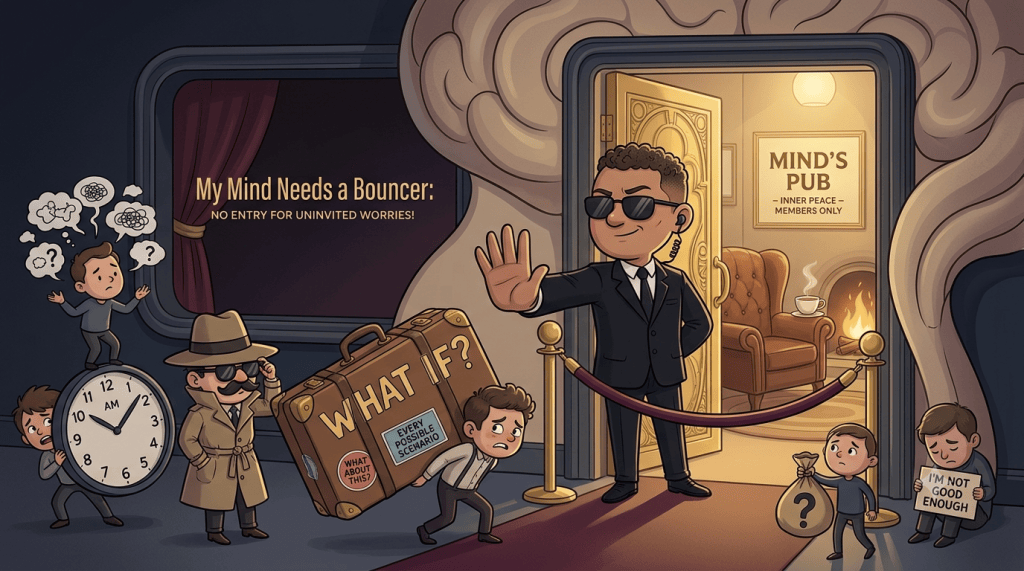
How do you stay resilient in hard times?
“Not every thought deserves VIP access to your mind. Some worries need nothing more than a polite NO ENTRY sign!”
Last Sunday, at precisely 2:14 AM, my brain decided to organise an uninvited late-night festival.
On the main stage was a highlight reel of every embarrassing thing I’d said since 2014. In the VIP lounge, a full-blown panic party was underway about my bank account, career, family drama and whether I’d remembered to lock the front door.
I lay staring at the ceiling, exhausted, wondering why I couldn’t simply be stronger.
And then it hit me.
My brain didn’t need more willpower. It needed a bouncer.
Think about a good nightclub bouncer. He doesn’t argue with unruly guests, panic over the crowd or get personally offended by every disturbance. He simply stands behind the velvet rope, looks at the chaos and says, “Sorry, you’re not on tonight’s guest list.”
When hard times hit, most of us do exactly the opposite.
We throw open the doors of our minds.
We give anxiety the best booth, hand the microphone to worst-case scenarios and allow self-doubt to run up a bill on our emotional credit card. By morning, we’re completely exhausted, and the unwanted guests are still dancing!
For years, I thought resilience meant being some kind of superhero who never felt fear, sadness or overwhelm.
I’ve gradually realised that resilience isn’t about having zero bad days. It’s about learning not to give every negative thought unlimited access to your mind.
Of course, life will throw difficult seasons at us. Bills will arrive, plans will collapse, people will disappoint us, and some days will feel like an uphill sprint in wet socks.
We cannot control every situation, but we can learn how much space we allow it to occupy in our heads.
So, I’ve decided to appoint an inner bouncer. His duties are quite straightforward:
1. Check IDs at the door.
Whenever a worrying thought arrives, ask: “Is this helping me solve a problem, or is it simply ruining my day?”
If there’s nothing useful to offer, it doesn’t get the VIP treatment.
2. Allow emotions in, but don’t hand them the microphone.
Sadness, disappointment, frustration and fear are human. They deserve to be acknowledged, not thrown out. But they don’t get to control the music, the lights and the entire evening.
3. Enforce closing time.
At 2 AM, the club is closed. No midnight meetings with imaginary disasters, no financial audits and absolutely no replaying conversations from ten years ago.
Tomorrow is another day. Worry can come back during office hours.
Perhaps that’s what resilience really looks like.
Not pretending everything is fine, not forcing ourselves to smile through every difficulty, but learning to protect the little peace we have while finding the strength to deal with whatever life sends our way.
And if life insists on creating another scene, well, my inner bouncer is now on permanent duty.
After all, life may have unlimited guest passes, but my mind is no longer an all-you-can-enter nightclub. 😂


17 responses to “My Mind Needs a Bouncer: No Entry for Uninvited Worries. 😂”
Good 👍
LikeLiked by 1 person
Thank you so much 🙏
LikeLike
Neat concept, there’s no need for more worries
LikeLiked by 1 person
Thank you so much 👍🙏
LikeLike
If you had to name this bouncer, what would you call him? Stoic, Sentinel, Firewall, Unbothered or Thick Skin? 😄
LikeLiked by 2 people
Firewall 😄 Nothing gets past him, and he looks like he’s seen every excuse in the book. Though “Unbothered” is a close second, because that calm face says “I’ve heard it all before.” 😎
LikeLiked by 1 person
Well written, I think we all need an inner bouncer. The trouble is that some of our worries arrive disguised as VIP guests, and we keep letting them in! Perhaps the first lesson in resilience is learning when to show them the exit.
LikeLiked by 1 person
Thank you so much 😊 “Worries disguised as VIP guests” is such a great twist, and so true. They always arrive with confidence and a fancy outfit, and we hold the door open. 😄 Here’s to better guest-list management and showing the uninvited ones the exit.
LikeLiked by 1 person
Welcome, my friend.
🙏
LikeLiked by 1 person
I love this bouncer concept, it fits well in accordance with self mastery.
LikeLiked by 1 person
Thank you 😊 Glad the bouncer concept clicked with you. Self-mastery is really just good door policy: knowing which thoughts deserve a seat and which ones get politely escorted out.
LikeLiked by 1 person
Good advice. Thank you.
LikeLiked by 1 person
Thank you Peter 😊 for liking my post 🙏
LikeLike
That is an interesting rhetoric
LikeLiked by 1 person
Thank you so much 🙏💐
LikeLiked by 1 person
“Your bouncer is on the worst shift — nobody’s at the door at 2:14 AM. Does writing it down work better than trying to stop it?”
LikeLiked by 1 person
Oh,love that image. 😄 The 2:14 AM shift is brutal, because the bouncer is asleep and every worry gets in without ID. For me, writing it down usually works better than fighting it. Once a thought is on paper, it stops pacing the dance floor and can wait until morning.
LikeLike