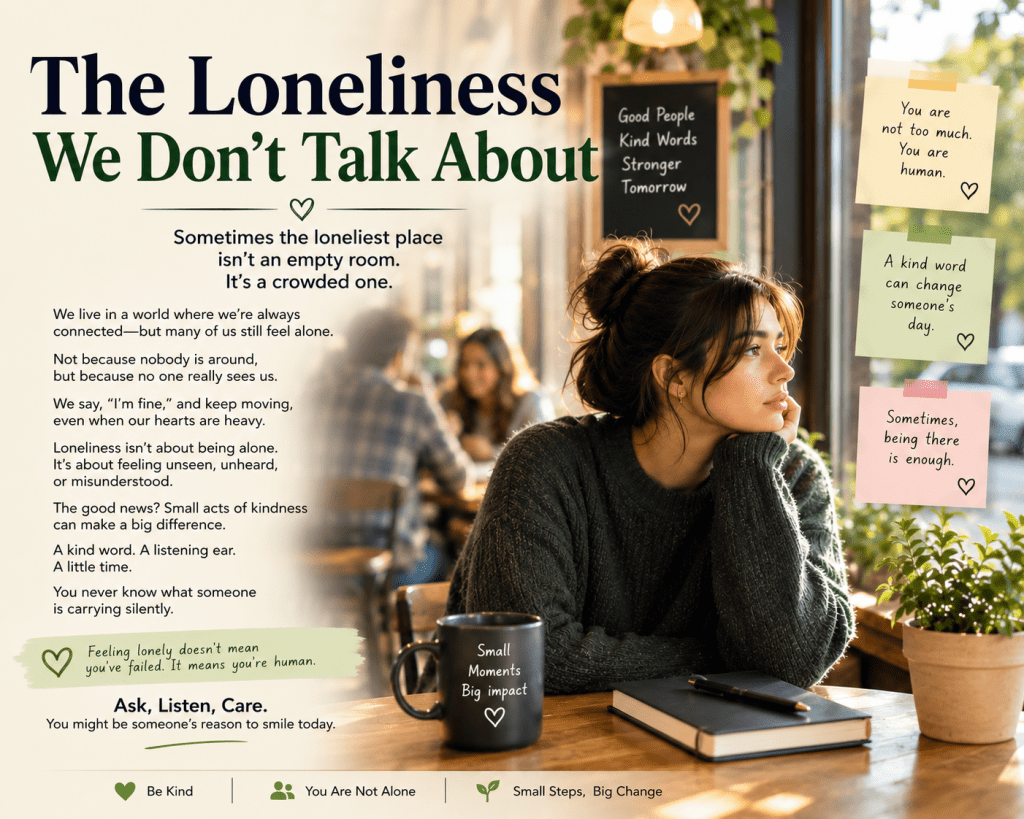
Sometimes the loneliest place isn’t an empty room. It’s a crowded one.
Last Sunday, I visited a busy café.
Every table was occupied. Friends laughed over coffee, families chatted excitedly, and almost everyone had a phone in hand. It looked like the perfect picture of connection.
Then I noticed a young woman sitting alone by the window.
She wasn’t scrolling through social media. She wasn’t reading a book.
She was simply staring outside, lost in thought.
For a brief moment, our eyes met. She smiled politely, then looked away.
I don’t know her story.
Maybe she was waiting for someone.
Maybe she had just received good news.
Or maybe she was carrying a burden no one around her could see.
That small moment stayed with me.
It reminded me that the deepest loneliness isn’t always about being alone.
Sometimes it’s about feeling unseen.
We live in a world where we’re connected every second. We can send messages across continents, join video calls, and share photos with hundreds of people in an instant.
Yet many of us quietly carry thoughts we’ve never told anyone.
We answer, “I’m fine,” because it’s easier than explaining why we’re not.
Psychologists call this emotional loneliness, the feeling that no one truly understands what you’re experiencing, even when you’re surrounded by people.
It’s more common than we think.
And perhaps that’s why the smallest acts of kindness leave the biggest impact.
A friend who notices you’re unusually quiet.
A neighbour who asks how you’re doing and waits for the real answer.
A colleague who remembers something you mentioned weeks ago.
These moments don’t seem extraordinary.
But to someone feeling invisible, they can mean everything.
I’ve come to believe that most people aren’t looking for perfect advice.
They’re looking for a safe place to be honest.
Maybe that’s why a genuine conversation feels so rare today.
We’re surrounded by voices, yet we often struggle to find someone who truly listens.
If this article resonates with you, I want you to remember one thing:
Feeling lonely doesn’t mean you’ve failed at life.
It means you’re human.
And chances are, someone sitting next to you today is carrying the very same feeling.
So before you ask someone, “What have you been up to?”
Try asking,
“How have you been really?”
You might not change the whole world.
But you could change someone’s day.
And sometimes, that’s exactly where healing begins.

