There’s a verse tucked inside one of the most famous compositions in Hindu philosophy — Adi Shankaracharya’s Bhaja Govindam , that goes:
“Punarapi jananam, punarapi maranam, punarapi janani jathare shayanam.”
Translated simply: “Again birth, again death, again sleeping in a mother’s womb.”
It sounds almost like a sigh. And in a way, it is. This one line captures one of the oldest and most profound ideas in Indian spiritual thought — the idea that we don’t live just once. We live again, and again, and again, until we finally learn what we came here to learn.
This is the concept of samsara — the cycle of birth, death, and rebirth — and it’s worth understanding, because it shapes how millions of people think about life, death, and everything in between.
What Exactly Is Samsara?
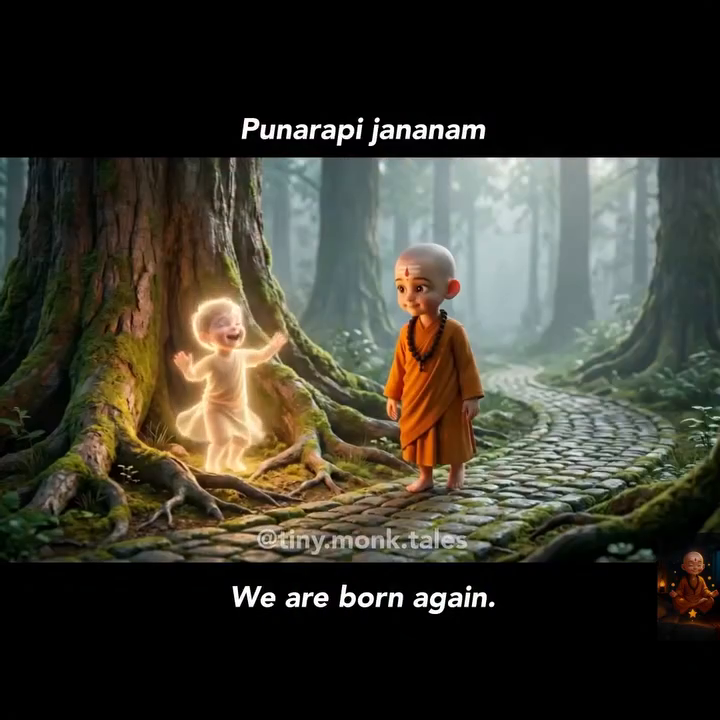
In Hindu philosophy, the soul — called the atman — is considered eternal. It doesn’t begin at birth or end at death. Instead, it moves through an endless sequence of bodies and lifetimes, a bit like changing clothes. The Bhagavad Gita puts it plainly: just as a person discards worn-out garments and puts on new ones, the soul discards a worn-out body and takes on a new one.
Death, in this view, isn’t an ending. It’s a transition — a doorway into the next chapter.
“As a person puts on new garments, giving up old ones, similarly, the soul accepts new material bodies, giving up the old and useless ones.”— Bhagavad Gita, Chapter 2, Verse 22
Why Do We Come Back at All?

This is where it gets genuinely interesting. Hindu philosophy doesn’t treat reincarnation as random. It’s governed by karma — the law of cause and effect applied to our actions, thoughts, and intentions.
Every choice we make leaves an imprint. The kindness we show, the anger we hold onto, the promises we keep or break — all of it accumulates. And according to this tradition, we return to earth, life after life, specifically to work through that karma and learn the lessons we haven’t yet learned.
Think of it less like punishment and more like a very long school year. If you don’t grasp a lesson the first time, life — quite literally — gives you another shot at it, sometimes in a completely different form: a different body, family, gender, country, even species.
“As is a man’s desire, so is his destiny. For as his desire is, so is his will. And as his will is, so is his deed. And as his deed is, so is his reward, whether good or bad.”— Katha Upanishad
The Wheel That’s So Hard to Escape

There’s another line from the same verse: “iha samsare bahu dustare” — “in this world, so difficult to cross.” Samsara is often described as a wheel, or an ocean, precisely because it’s so easy to get caught in it and so hard to get out.
Why is it hard? Because every lifetime brings fresh desires, fresh attachments, fresh karma — and each of those tends to pull the soul right back into the cycle. It’s less like climbing a ladder and more like running on one of those old water wheels: a lot of motion, but you stay in the same place unless something fundamentally shifts.
“Punarapi jananam, punarapi maranam, punarapi janani jathare shayanam.” — “Again birth, again death, again resting in a mother’s womb.”— Adi Shankaracharya, Bhaja Govindam
So What Actually Ends the Cycle?

This is where the philosophy becomes less about fear and more about hope. The goal was never to keep spinning forever. The end goal is moksha — liberation. It’s the point at which the soul has learned enough, let go of enough attachment and ego, and realized its true nature, that it no longer needs to return.
The Bhaja Govindam verse itself points toward the way out. After describing the exhausting cycle of birth and death, Shankaracharya doesn’t leave us stuck there. He offers the remedy in the very next line:
“Bhaja Govindam, bhaja Govindam, Govindam bhaja mudha-mate” — “Worship the divine, worship the divine, O foolish mind, worship the divine.”
In other words: stop chasing the fleeting things — wealth, youth, ego, attachment — that keep the wheel turning, and turn your attention instead toward the eternal. That, according to this tradition, is the real shortcut off the wheel.
Coming Full Circle

What I find genuinely moving about this philosophy is that it doesn’t treat any single lifetime as the whole story. A hard childhood, an unfair loss, an unanswered “why me” — in this worldview, none of it is the final word. It’s one chapter of something much longer, and every chapter is an opportunity to grow a little wiser than the last.
Whether or not you personally believe in literal reincarnation, there’s something universally useful in the idea: that we’re all works in progress, that our choices ripple forward, and that growth is rarely a one-shot deal. Sometimes we need to fall back into old patterns a few times before the lesson finally sticks.
Maybe that’s why this idea has survived for thousands of years. It doesn’t just explain what happens after death — it gently reminds us how to live.
“The soul that has traveled through a thousand lifetimes is not lost — it is simply still learning its way home.”
A respectful note for readers: Samsara, karma, and moksha are deep and nuanced concepts within Hindu philosophy, discussed across scriptures like the Bhagavad Gita, the Upanishads, and works like Bhaja Govindam. This post offers a simple, accessible introduction and not a substitute for the wisdom of those original texts or or the guidance of scholars and teachers within the tradition.

