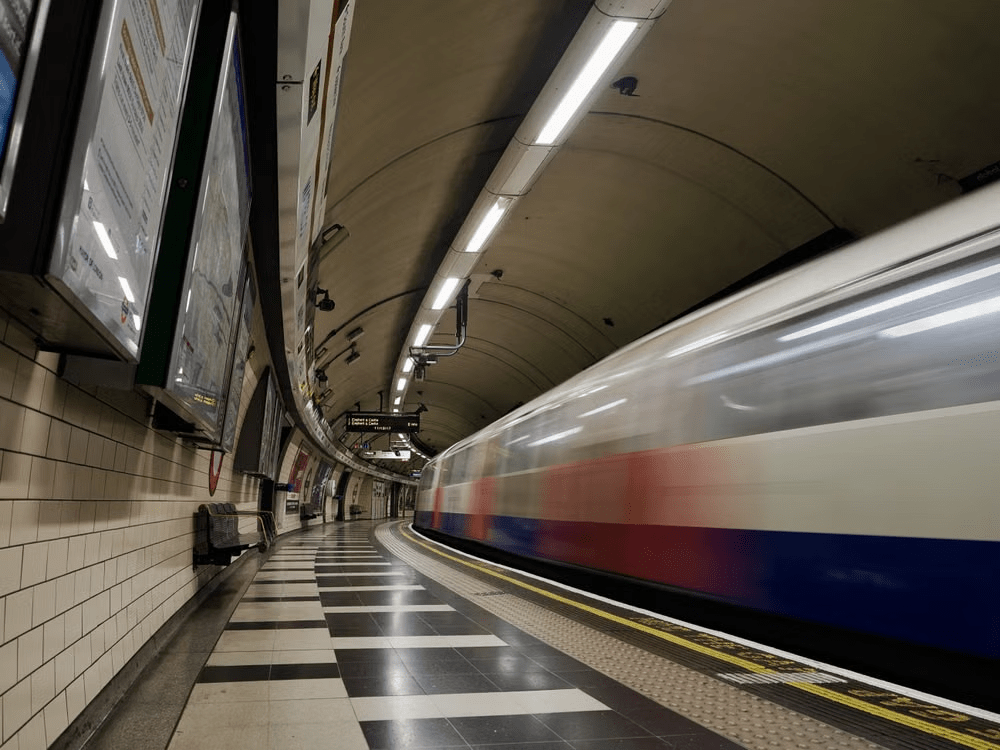
During the Blitz, when German bombers appeared over London’s skies, thousands of residents sheltered in the city’s deepest Underground tunnels, sleeping on platforms and in disused stations to escape the air raids above. Survivors later described an additional, smaller misery down there: mosquitoes, biting through the night, in a place where no mosquito should logically have been able to live.
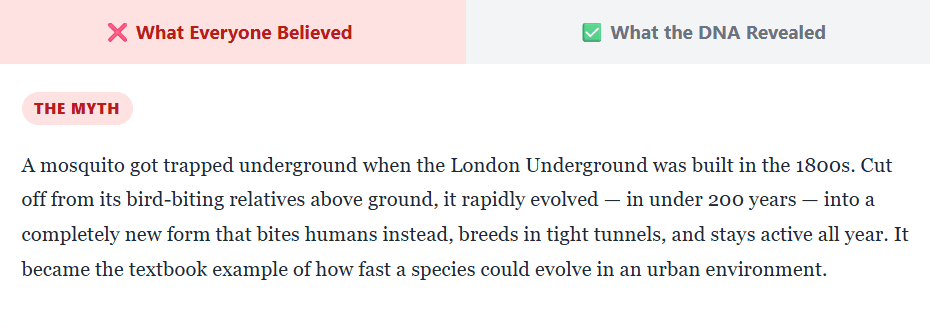
For decades afterward, that wartime detail grew into one of the most famous case studies in evolutionary biology a textbook example of a species evolving, from scratch, in less than a century. It turns out the story was wrong. The real explanation, confirmed by genetic research published only in late 2025, is stranger and considerably older.
A Mosquito With Two Identities
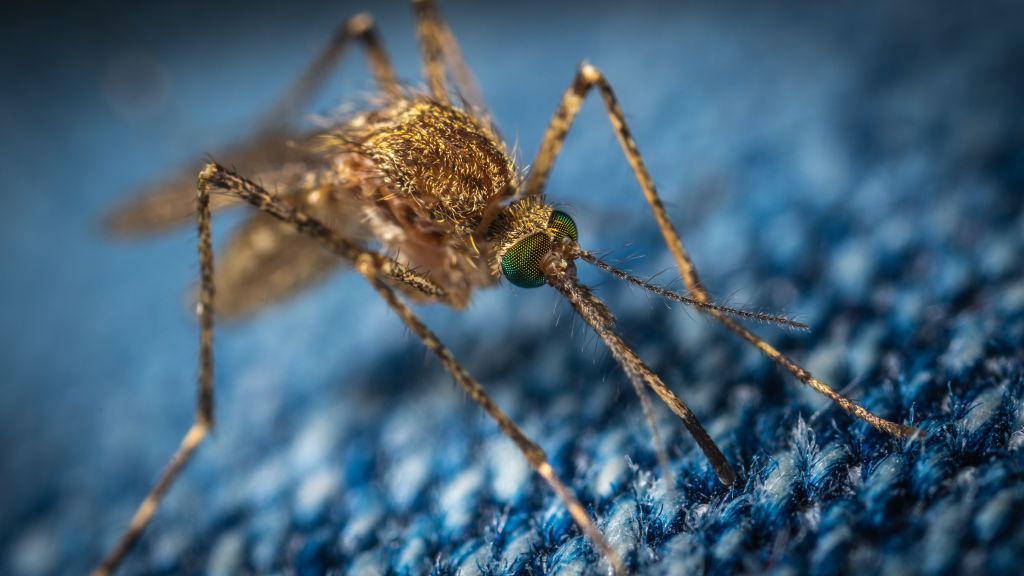
The common house mosquito, Culex pipiens, exists in two forms that look identical under a microscope but behave very differently. The aboveground form bites birds almost exclusively and goes dormant through winter, like most temperate insects. The other form, known as molestus, does something stranger: it bites humans, mates in cramped enclosed spaces, stays active year-round, and can even lay its first batch of eggs without feeding on blood at all.
Because molestus turns up reliably in subways, basements, and sewers across northern Europe, Asia, and North America — and was first formally described from London Underground specimens — the leading theory for nearly a century was that it evolved right there, isolated by the tunnels themselves.
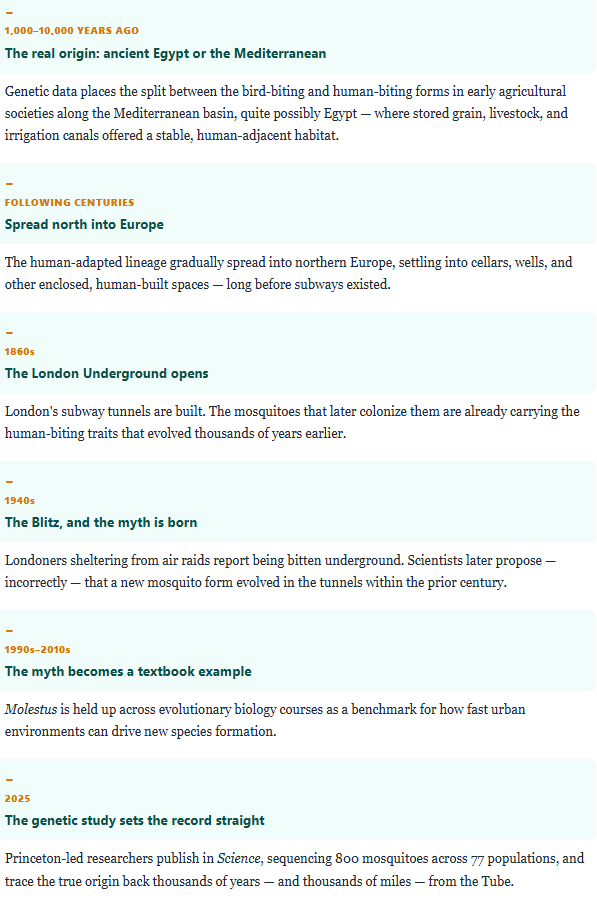
An Interactive Timeline: The Mosquito’s Real Journey
Let us see how the timeline actually unfolded.
They have devolped unique characterstics that allow them to survive in diverse enviroments.
What the DNA Actually Said
A team led by researchers at Princeton, publishing in the journal Science in late 2025, decided to test the old story properly. They built the largest genetic dataset ever assembled for this mosquito, sequencing roughly 800 specimens — including historical museum samples — from 77 populations spanning Europe, North Africa, and western Asia.
Why the Real Story Is More Interesting

The corrected timeline doesn’t make the mosquito less remarkable — it makes it a different kind of remarkable. Rather than illustrating rapid evolution in two centuries, it’s now considered a textbook case of exaptation: traits that evolved for one purpose, in one environment, turning out to be perfectly suited for an entirely different environment thousands of years later. The toolkit that let this mosquito thrive among ancient farmers comfort in enclosed spaces, year-round activity, reduced dependence on blood for reproduction happened to be exactly what was needed to colonize subway tunnels millennia after it first evolved.

The Lesson Underneath the Lesson
The London Underground mosquito had been cited in textbooks and lecture halls for so long that almost no one thought to seriously question it. It took a genetic dataset spanning 77 populations and two continents to reveal that one of evolutionary biology’s mostr epeated urban legends wasn’t really about the city at all . it was about a journey that began thousands of years earlier, in fields along the Nile.
It’s a useful reminder that even our most confidently repeated stories about urban nature are worth double-checking. Sometimes the science underneath a city tells a far older story than the city itself.
 Healing through words 😄