May 27, 2026. 9 min read. Technology & Careers
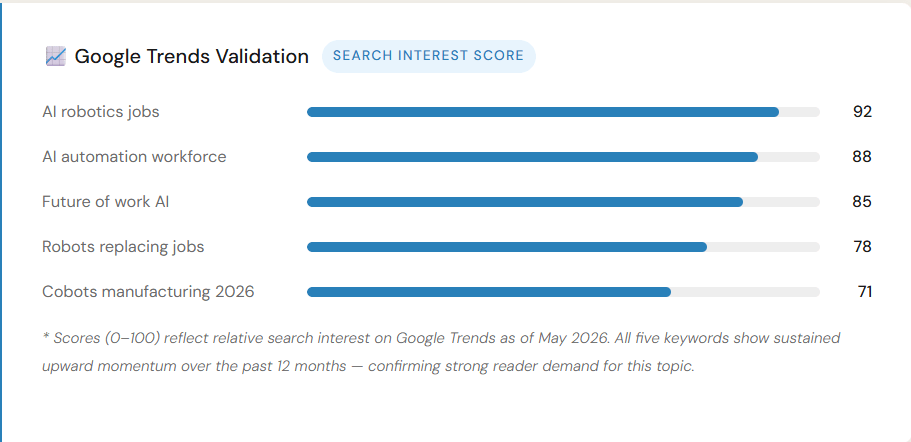
📈 Google Trends Validation Search Interest Score
I’ve been watching the factory floor change for years but nothing prepared me for walking into a modern warehouse in 2026 and seeing machines that don’t just move, they think. Robots that pause when a person steps too close. Robots that ask questions, and doing real jobs that didn’t exist three years ago. This is the story nobody is telling properly.
▶ Watch Before You Read
▲ These AI robots are already working in warehouses, factories, kitchens, and offices right now (YouTube, 2025)
Let’s Be Honest: The Old Robot Is Dead
Remember those old car factory videos, a mechanical arm welding the same seam, again and again, at exactly the same angle, forever? That robot was impressive, sure. But change the part, and the whole line stopped. It needed humans to babysit every deviation.
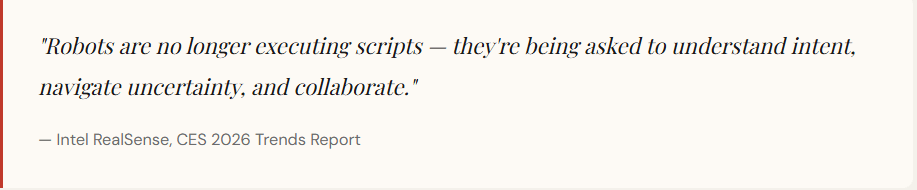
That era is genuinely over. What’s taken its place isn’t just a faster version of the same thing. Today’s AI-powered robots perceive, decide, and adapt in real time. They can switch tasks mid-shift, recognize a damaged component, step around a moving colleague, and even flag anomalies their operators hadn’t thought to look for.
This shift happened because of a convergence of things arriving at the same time: cheap edge computing, real-time computer vision, and large language models that can process sensor data and make decisions faster than any human supervisor could. The result? A robot that doesn’t just execute but it understands.
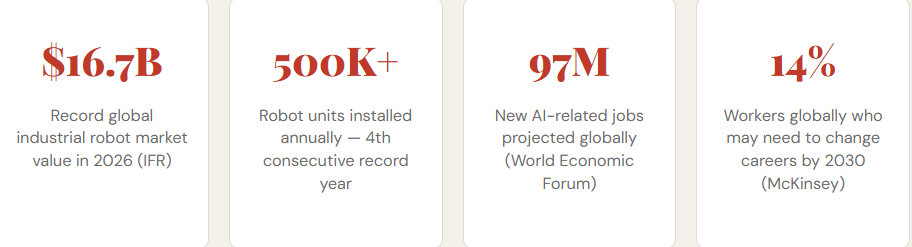
So What’s Actually Happening to Jobs?
Here’s the question everyone is really asking: will I still have a job in five years? The honest answer and I know it’s frustrating is: it depends. Not on your industry, and not really on how hard you work. It depends on whether your job is built on repetition or on judgment.
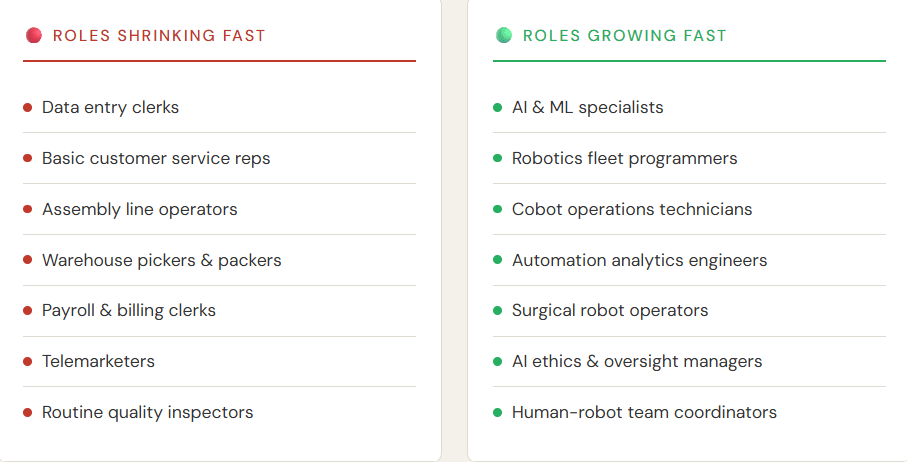
Jobs built around doing the same predictable thing over and over like data entry, assembly line work, basic customer queries, routine quality checks are genuinely shrinking. Not because companies are being cruel, but because a machine can do those tasks faster, cheaper, and without a lunch break. That’s just the reality.
But here’s what most headlines leave out: those same companies are desperately hiring for roles that didn’t exist before. People who can program robotic fleets. People who can interpret AI outputs and translate them into business decisions. People who can manage the relationship between a human team and a machine team.
A 2026 workplace survey that tracked companies which had already deployed AI tells a story that surprises most people. Only 7% reported actual job cuts but 24% had created brand new roles, and 57% said they were actively running reskilling programs. In most cases, AI didn’t eliminate the worker. It changed what the worker needed to do.
The Cobot: Your New Coworker
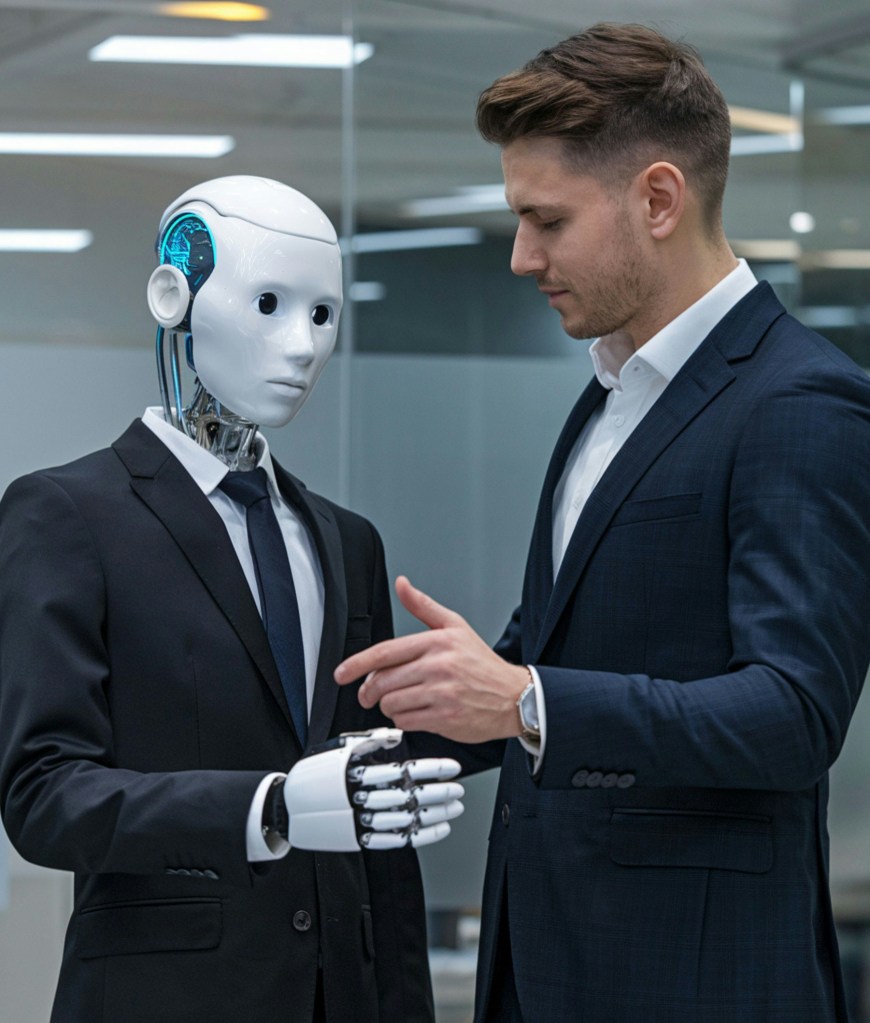
If you asked me to pick one technology that sums up where this is all heading, I’d say collaborative robots/cobots. These aren’t the big scary machines behind safety cages. They’re designed from the ground up to work right next to you.
Walk into a modern car plant today and you’ll see it: a cobot handles the torque-sensitive fastening and the heavy lifting while the human alongside it focuses on the judgment calls and the visual check, the exception, the thing that doesn’t quite look right. Neither one is doing the other’s job. Together, they’re doing something neither could pull off alone.
Companies that have embraced this model aren’t just seeing productivity gains. They’re seeing fewer repetitive strain injuries, lower turnover in physically demanding roles, and surprisingly higher worker satisfaction. It turns out people don’t actually love tightening the same bolt 600 times a shift.
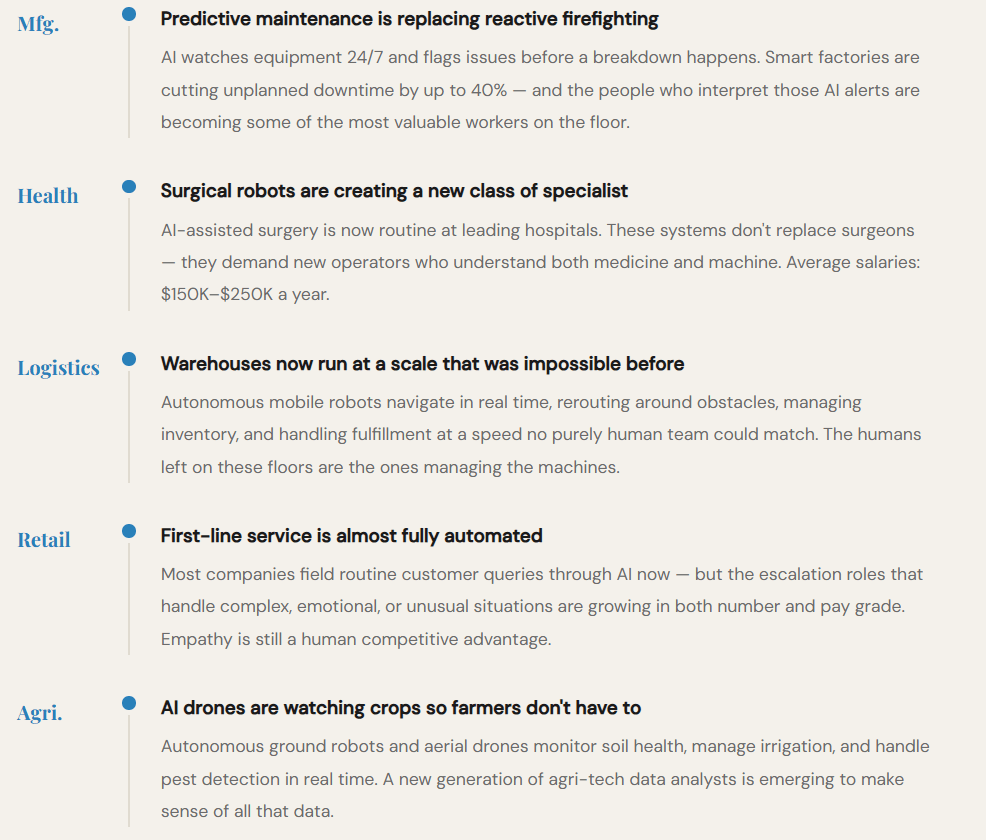
Industry by Industry: What’s Changing Right Now
The Real Crisis: The Skills Gap Nobody Talks About
Here’s what keeps HR directors up at night in 2026: it’s not too many robots. It’s not enough people who know how to work with them. The International Federation of Robotics flagged this as one of the top pressures on the industry this year, employers worldwide are leaving positions unfilled because the talent simply doesn’t exist yet. In the meantime, their existing staff are covering extra shifts and burning out.
The World Economic Forum’s estimate that one billion workers globally will need some form of reskilling sounds alarming. But here’s a more grounding way to think about it: that’s one billion people with a learning opportunity. The fastest-growing skills aren’t exotic or out of reach but they’re AI literacy, data interpretation, and the ability to manage automated workflows. Things that can be learned.
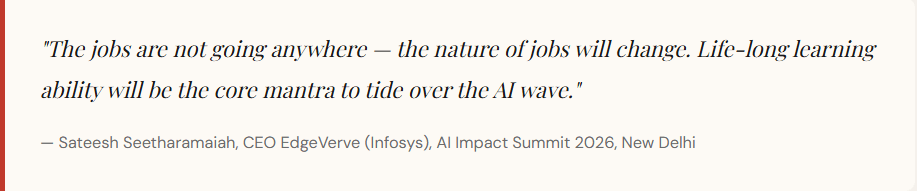
Companies are waking up to this. Amazon pledged to retrain hundreds of thousands of employees. Bootcamps focused on cobot operations and automation analytics are popping up everywhere, including right here in India. The message from industry leaders at the AI Impact Summit 2026 in New Delhi was simple and direct: stop panicking and start learning.
What Should You Actually Do About It?
If you’re a worker wondering whether your job is safe, I’ll give you the same advice I’d give a friend over coffee: stop asking whether your job is safe and start asking what skills would make you indispensable in a workplace where machines handle the routine. Judgment, creativity, emotional intelligence, and the ability to supervise and interpret AI output those are not going anywhere.
If you’re running a business, the biggest mistake you can make right now is treating automation as a way to cut headcount and call it a day. The companies pulling ahead aren’t the ones with the most robots. They’re the ones who’ve invested in helping their people work alongside those robots effectively. That combination which is human judgment plus machine precision is producing results neither can achieve alone.
The future isn’t humans versus machines. It never really was. It’s about who learns to make the two work together.
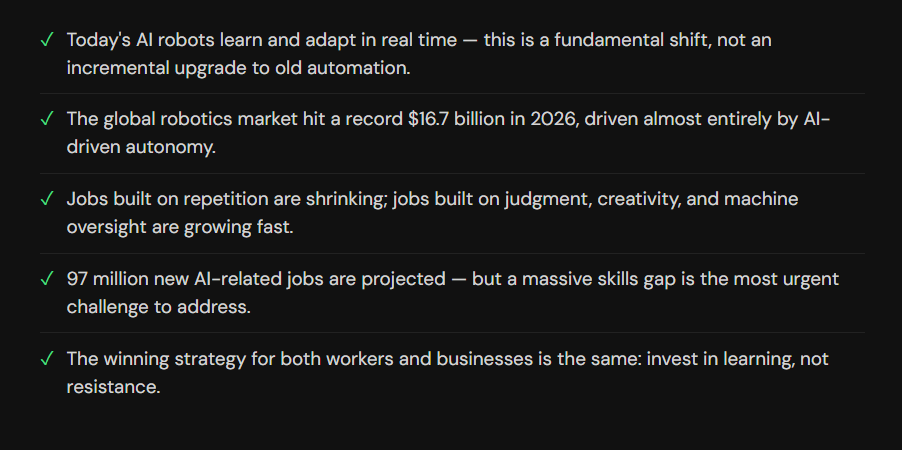
Key Takeaways