Health advice is everywhere , on social media, in family WhatsApp groups, on cereal boxes, and in conversations with well-meaning friends.
But the problem is not all of it is true.
Some ideas sound so convincing that we accept them as facts without ever questioning them. But Research often tells a different story.
So let’s clear the fog.
Here are five common health myths that deserve a closer look and the research-backed truths that can actually help you live better.
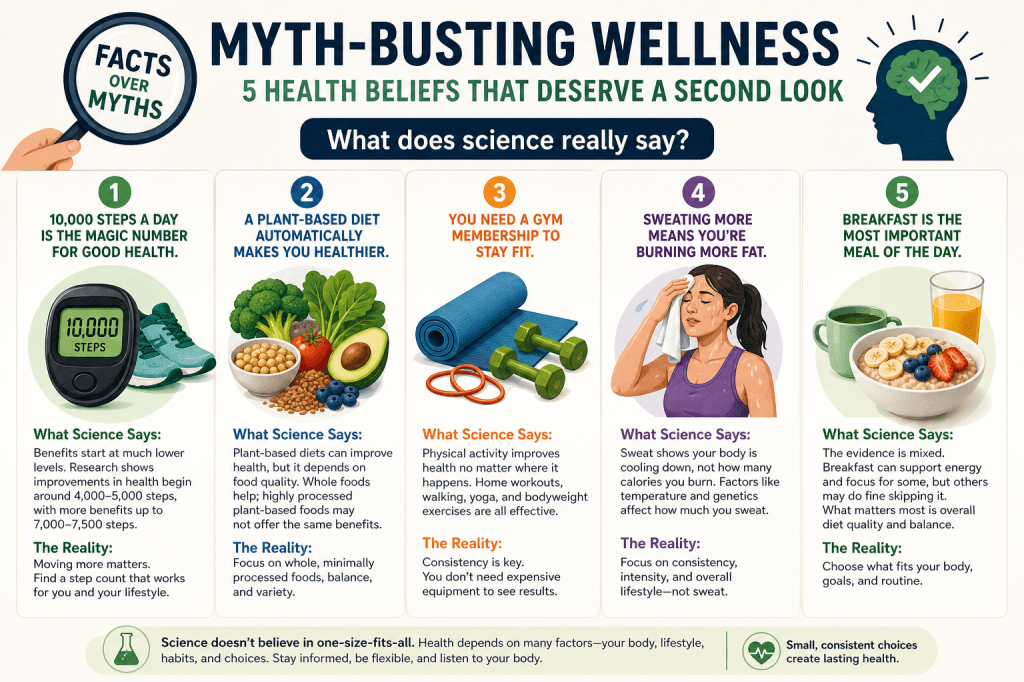
1. Myth: 10,000 Steps a Day Is the Magic Number for Good Health.
We’ve all heard it: 10,000 steps a day is the golden rule for fitness. It’s a clean, motivating number, often programmed as the default goal on smartwatches and fitness trackers. But while active lifestyles are undoubtedly beneficial, the number 10,000 itself has surprisingly non-scientific origins.
The Origin: Marketing, Not Medicine
The Fact:
The 10,000-step benchmark did not originate from a medical study. It began as a marketing tool. In Japan going back to 1964 Tokyo Olympics. A company launched a pedometer called the Manpo-kei, which translates directly to “10,000 steps meter”.
The number was chosen because the Japanese character for 10,000 (万) vaguely resembles a person walking, and it was a memorable, catchy target to motivate the public.
What This Means:
If 10,000 steps is a motivating number for you, feel free to keep it. It’s not harmful. However, if it feels daunting, unachievable, or discourages you, feel free to ignore it.
You do not need to chase a perfect number.
Walking more than you currently ,do matters far more than hitting a fixed target. For some people, 6,000 steps may be a huge win. For others, 8,000 feels natural.
Movement should be the goal, — not a magic number.
2. Myth: A Plant-Based Diet Means, You’ll Automatically Be Healthier.
Plant-based eating has earned a strong reputation — and for good reason. Diets rich in vegetables, fruits, legumes, and whole grains are linked to better heart health, lower inflammation, and improved long-term wellness.
But “plant-based” is not automatically equal to “healthy.”
The Fact:
Quality matters more than labels.
A plate full of vegetables, lentils, nuts, and whole grains is very different from a diet built around fries, sugary cereals, refined breads, and heavily processed vegan snacks.
Research shows that healthy plant-based diets are associated with reduced risk of chronic disease, while unhealthy plant-based patterns can still increase health risks.Following a plant-based diet, especially a strict vegan one, requires thoughtful planning to avoid serious deficiencies.
What This Means:
A plant-based diet works best when it is balanced and nutrient-rich.
Focus on variety, protein sources like beans and lentils, healthy fats, and minimally processed foods. Simply removing animal products does not guarantee better health.
Plants are powerful — but choices still matter.
3. Myth: You Need a Gym Membership to Stay fit.
It is absolutely a myth that you need a gym membership to stay fit. While gyms offer convenience, specialized equipment, and a dedicated environment, your body doesn’t know the difference between lifting a steel dumbbell in a commercial facility or doing a push-up in your living room.
The Fact:
Your body is the best machine you’ll ever own,
Your Diet and consistency, not a membership, is the true key to fitness”.
What This Means:
The most expensive gym membership in the world won’t make you fit ,if your nutrition is poor and you only show up once a month
Fitness is built through consistency, not membership fees.
A 20-minutes home routine done four times a week often beats an unused gym plan.
The best workout is the one you can actually stick with.
4. Myth: Sweating More Means You’re Burning More Fat.
Sweat, often mistaken as a measure of a grueling workout and fat burning.but in reality it is simply your body’s cooling mechanism.
The Fact:
Sweat indicates the body is active and generating heat, just as dripping water shows a car’s AC is operating. However, like the car, it signals function rather than high efficiency or the amount of work being done.
Let’s shift our perspective. Instead of focusing on how much you sweat, concentrate on consistent exercise and a balanced diet.
Fat loss happens when your body uses stored energy over time ,not because sweat is dripping from your forehead.Fat loss, a product of a caloric deficit, isn’t directly tied to sweat output.
What This Means:
Do not judge workout quality by how soaked your shirt becomes.
Instead, look at energy levels, strength gains, endurance, and overall consistency.
Sweat measures heat — not success.
5. Myth: Breakfast Is the Most Important Meal of the Day
This phrase has shaped breakfast tables for generations.
Many people believe skipping breakfast slows metabolism or harms health.
The Origin:
The origin of the phrase “breakfast is the most important meal of the day” is widely attributed to a clever and highly successful advertising campaign.
In 1917, the newly formed “Cereal Institute” (associated with companies like Kellogg’s) was trying to convince people to eat more breakfast cereal, which was a convenient and alternative to the heavier, cooked breakfasts of the past. To promote their product, they launched a marketing campaign with this memorable slogan,
The Fact:
The evidence is mixed. Some studies show breakfast improves concentration, mood, and appetite regulation ,especially in children, students, and active individuals.
Other research suggests that skipping breakfast does not automatically damage health, as long as total nutrition throughout the day remains balanced.
Meal timing may be flexible depending on lifestyle, hunger patterns, and personal goals.
The Reality:
For some, breakfast sets the tone for the day.
For others, a later first meal works just fine.
The science does not support one universal rule.
The Bigger Lesson:
“Health Is Personal, Not One-Size-Fits-All”.
The reason health myths survive is because they often contain a small piece of truth.
But human bodies are complex. Age, routine, goals, culture, and genetics all shape what works best from individual to individual.
Science rarely gives black-and-white answers ,it offers context.
And that context is what helps us make smarter, more sustainable choices.
Because real wellness is not about following every popular rule.
It is about understanding your body and using evidence to guide, not control, your decisions.
The Bigger Truth: Health Is Not Built on Myths
The wellness world often sells shortcuts, fixed rules, and its all-or-nothing but Marketing with catchy slogans
But real health is more flexible than that.
It is built through everyday choices: moving your body, eating balanced meals, resting well, and staying consistent over time.
Sometimes the healthiest thing you can do is question yourself “what is good for me?
Because when myths are replaced with facts, health becomes less confusing and much more achievable.
Final Thought:
You do not need to be perfect. You do not need expensive plans, extreme diets, or impossible goals.
You just need information that is honest, practical, and rooted in reality.
And that is where true wellness begins.
 Healing through words 😄